
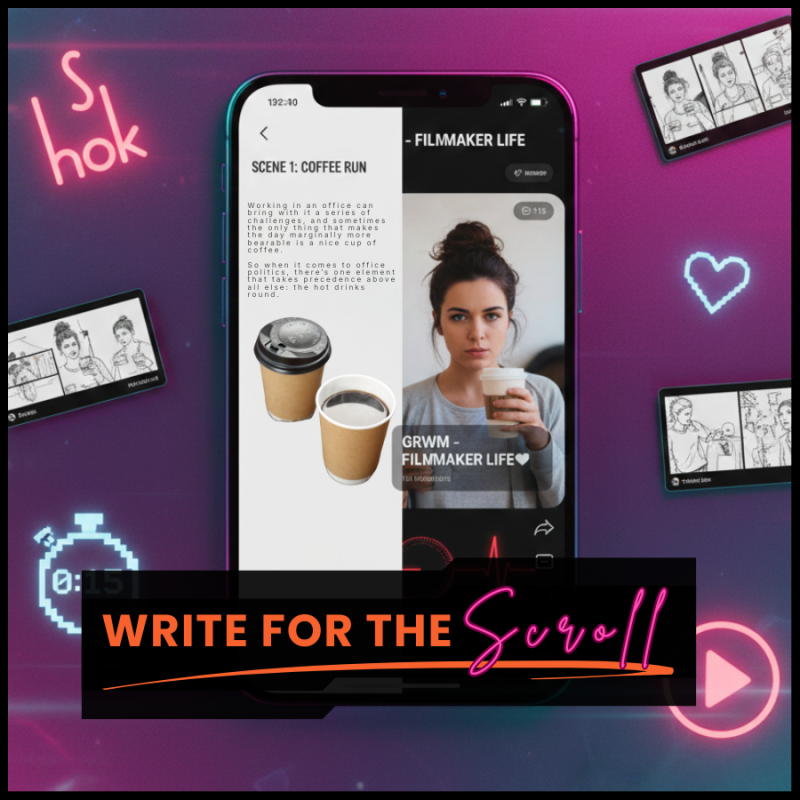
The way audiences consume stories has changed—and screenwriters who understand short-form storytelling have a massive advantage. With platforms like TikTok, Instagram Reels, and YouTube Shorts reshaping attention spans, filmmakers must learn to tell compelling stories in seconds, not minutes.
But writing for the TikTok generation isn’t about “dumbing down” your work. It’s about sharpening your storytelling instincts. It’s about clarity, density, rhythm, and emotional precision.
Below are the core techniques that help screenwriters thrive in the short-form landscape.
1. Start With an Instant Hook
Short-form viewers decide within 1–3 seconds whether they’ll keep watching. That means you can’t afford slow intros or atmospheric build-up.
Hook Types That Work
- A question: “What would you do if your roommate vanished overnight?”
- A bold visual: A character dangling from a rooftop railing.
- A contradiction: A firefighter afraid of fire alarms.
- A strong emotional statement: “I found out my boyfriend was cheating 10 minutes before this video.”
Why Hooks Matter
Your hook isn’t just bait—it’s a promise. It signals tone, genre, stakes, or conflict immediately. Once viewers understand what’s at stake, they’ll keep watching.
2. Build Micro-Story Arcs
Traditional scripts follow three acts.
Short-form scripts follow micro-arcs, often compressed into 6–20 seconds.
The Micro-Arc Formula
- Setup — Who are we watching, and what’s the situation?
- Turn — The complication, surprise, or shift.
- Payoff — The joke, twist, reveal, cliffhanger, or emotional punch.
Because the runtime is tight, every line of action must advance the arc.
Examples
- Comedy:
Setup: “I finally joined the gym.”
Turn: Trainer asks if you’re ready.
Payoff: Cut to you sprinting out the door. - Thriller:
Setup: A woman enters an empty house.
Turn: She hears footsteps upstairs.
Payoff: Camera pans to show… someone else’s shoes at the door.
Short stories. Big impact.
3. Keep Characters Instantly Understandable
You don’t have time for complex backstories in short-form. Characters must be graspable at a glance.
Use Clear Character Archetypes
- The skeptic
- The dreamer
- The chaotic best friend
- The overconfident boss
- The exhausted roommate
You can still deepen them over a series, but clarity comes first.

Build Character Through Action
Instead of monologues, use:
- A gesture
- A costume element
- A prop
- A quick reaction
In short-form visual storytelling, one raised eyebrow can replace five lines of dialogue.
4. Embrace Vertical Visual Language
Writing for vertical video (9:16) changes everything—from framing to blocking to props.
Visual Writing Tips
- Write action that happens in layers: foreground + midground + background.
- Use tight shots to heighten emotional beats.
- Keep movement centered or directional for maximum viewer retention.
- Use props or environments that translate clearly in a narrow frame.
Movement toward the camera or away from the camera is more powerful than lateral movement.
5. Cut Dialogue in Half
Short-form scripts thrive on:
- subtext
- action-driven storytelling
- reaction beats
- non-verbal performance
If a moment can be shown instead of said, choose the visual every time.
Example
Instead of:
“Wow, I can’t believe my boyfriend forgot our anniversary again!”
Try:
A wide shot of her in a restaurant alone, holding two menus, blowing the candle out.
The audience gets it.
6. End With a Punch
Short-form stories need endings that stick.
Effective Payoffs
- A twist
- A cliffhanger
- A punchline
- A transformation

If your ending triggers emotion (laughter, shock, outrage, curiosity), viewers will watch again—boosting your algorithmic reach.
7. Write for Retention
Long-form storytelling aims to satisfy.
Short-form storytelling aims to retain.
This means:
- Ending with a question
- Creating loops
- Building anticipation
- Using quick cuts
- Structuring scripts around momentum
When viewers rewatch or share your content, your story wins.
8. Let Music, Sound, and Rhythm Shape the Script
On TikTok, sound design is not a post-production thought—it’s a writing tool.
Write With Audio Cues in Mind
- Beat drops
- Voiceovers
- Whip transitions
- Sound effects
- Popular audio memes
Sometimes the rhythm of the edit is the story spine.
9. Think in Episodic Micro-Series
You don’t have to cram everything into one 15-second video. Short-form excels in serialized storytelling, where each micro-episode adds depth.
Structure Example
Episode 1: She gets a mysterious note.
Episode 2: She decodes part of it.
Episode 3: Someone else finds out she has it.
Episode 4: She receives a warning.
Each episode needs:
- Its own micro-arc
- A compelling hook
- A must-see payoff
Micro-worldbuilding leads to massive audience investment.

10. Keep Your Themes Big, Even When Your Format Is Small
Just because the runtime is short doesn’t mean the message has to be.
Common TikTok-ready themes:
- Identity
- Friendship
- Betrayal
- Self-discovery
- Social pressure
- Ambition
- Fear
- Humor as survival
Short-form doesn’t limit depth—it focuses it.
11. Polish the Script for Speed and Precision
Before shooting, run your script through these filters:
Retention Checklist
- Does the hook land in the first 0–3 seconds?
- Is every moment essential?
- Are your characters clear immediately?
- Does the pacing match the emotion?
- Does the ending leave a lasting effect?
Short-form scripting is the ultimate edit discipline.
A Resource to Elevate Your Craft
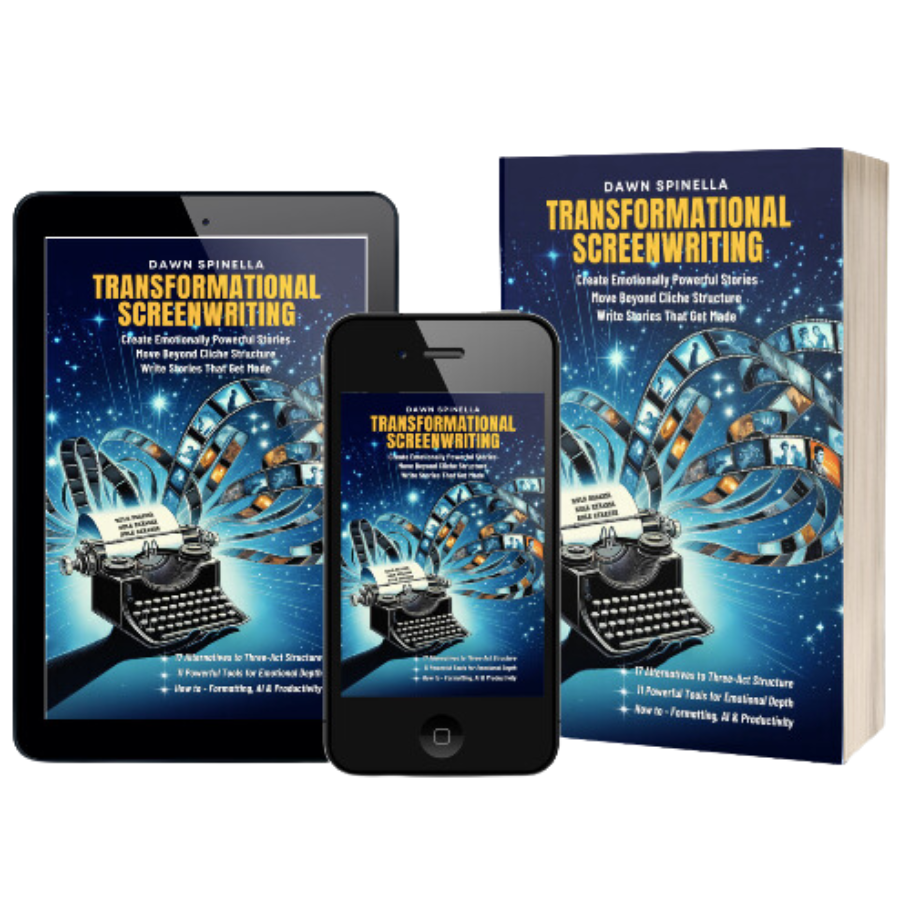
If you want to deepen your storytelling, strengthen character arcs, and build emotionally resonant scripts—no matter the format—Transformational Screenwriting is an invaluable guide. It offers frameworks that help writers create powerful internal journeys, even within short-form storytelling.
By mastering transformation, your short-form stories won’t just attract attention—they’ll leave an impact.
📘 Discover more on Amazon: Transformational Screenwriting