

Getting honest, professional feedback is one of the most valuable steps in your writing journey. It can also be one of the most overwhelming. Script coverage, reader notes, peer feedback—suddenly, your story has a dozen opinions attached to it. What now?
Used correctly, feedback can transform your screenplay into a sharper, deeper, more emotionally compelling piece of work. Used poorly, it can send you chasing endless rewrites with no direction.
Here’s how to use script coverage and reader feedback effectively—without losing your voice or your sanity.
1. Know the Purpose
Before diving into the notes, remember what coverage actually is: a tool for clarity. Readers evaluate scripts quickly and provide concise insights that help you understand how your story lands on a first read.
Coverage often includes:
- A summary
- Strengths
- Weaknesses
- Character notes
- Structure and pacing insights
- A verdict: Pass, Consider, or Recommend
Coverage is not a line-by-line workshop—it’s an industry snapshot of your script’s marketability and readability. Treat it as a high-level temperature check, not a judgment of your worth as a writer.
2. Read the Notes Once
The first read-through often triggers an emotional response (totally normal). Maybe you disagree. Maybe you feel misunderstood. Maybe you’re frustrated.
That’s why you read it once… then take a break.
Let your brain cool down before analyzing. Reflecting in a calmer state helps you see the gold in the critique and separate ego from opportunity.

3. Identify Patterns
One reader saying your protagonist feels passive = one opinion.
Three readers saying it? That’s a trend.
Pay attention to repetitive notes regarding:
- Character motivation
- Stakes and emotional clarity
- Scene redundancy
- Dialogue flatness
- Pacing issues
Patterns show you where the true weaknesses lie. A single outlier note should never trigger a full rewrite.
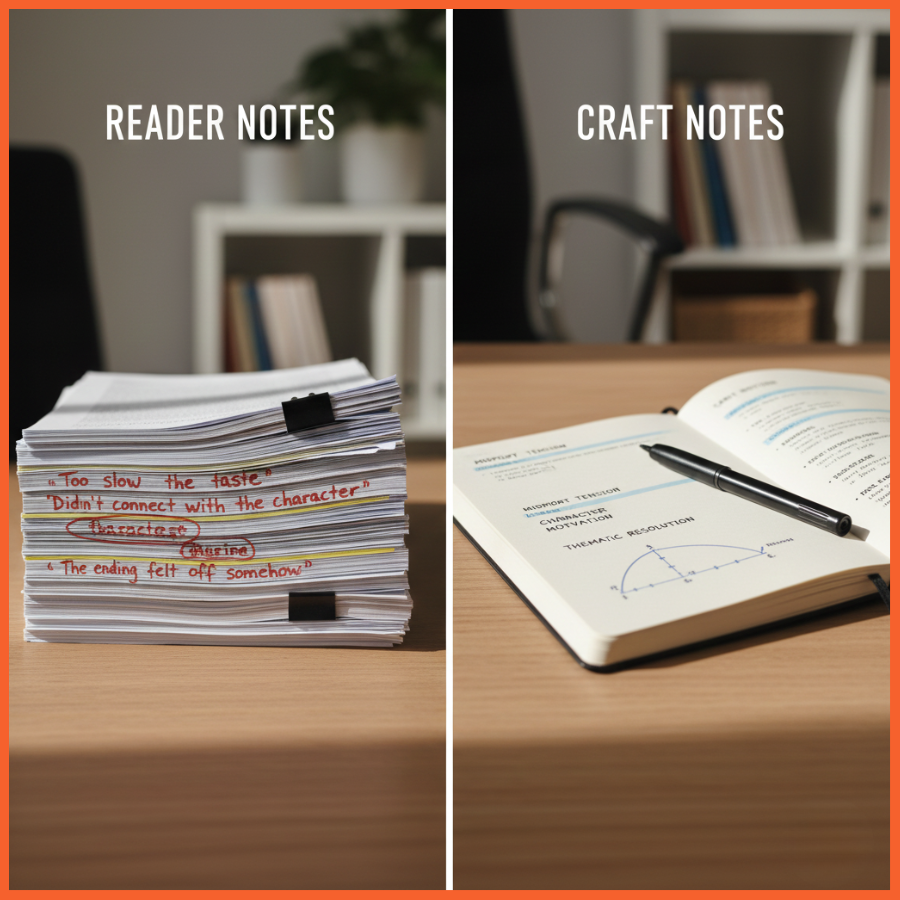
4. Separate Taste-Based Notes from Craft-Based Notes
Not all feedback has equal weight. Learn to distinguish:
Taste Notes
These reflect personal preference.
Example: “I don’t like sci-fi romance hybrids.”
Taste notes are optional. Smile and move on.
Craft Notes
These highlight clarity, structure, or emotional issues.
Example: “The midpoint lacks tension, and the protagonist has no clear objective.”
Craft notes require attention, even if you disagree at first.
5. Ask Clarifying Questions
If you’re working with a consultant or peer group, don’t be afraid to ask:
- “Can you explain what confused you in this scene?”
- “Did you feel the protagonist’s goal shifted clearly?”
- “Where did you lose interest?”
Clarity prevents misinterpretation and keeps your rewrite targeted. Notes are far more valuable when you fully understand the reader’s perspective.
6. Protect Your Voice
Feedback should strengthen your voice, not flatten it.
Before implementing notes, ask:
- Does this change support the story I want to tell?
- Does it align with my tone, theme, and intention?
- Is this note improving clarity—or just changing the style?
Rewrite with purpose, not fear. Your voice is your currency. Don’t trade it away trying to please everyone.
7. Create a Rewrite Roadmap
Instead of fixing everything at once (chaos!), break your revisions into clear phases:
Pass 1 – Structure:
Clarify goals, stakes, midpoint, and emotional turns.
Pass 2 – Characters:
Strengthen motivations, arcs, and relationships.
Pass 3 – Dialogue:
Sharpen rhythm, subtext, and scene specificity.
Pass 4 – Scene Work:
Trim excess, tighten transitions, improve pacing.
Pass 5 – Final Polish:
Tone consistency, action lines, formatting.
A roadmap prevents burnout and keeps your story grounded in purpose—not in the noise of too many notes.
Strengthen the Story Beneath the Feedback
Script coverage is most effective when your story’s emotional core is already strong.

Transformational Screenwriting focuses on character change, thematic power, and meaningful storytelling—ensuring your script resonates deeply before it ever reaches a reader.
When your characters evolve authentically and your structure supports that transformation, your coverage improves naturally, and your revisions become far more focused.
Use feedback to refine—not reinvent—your narrative purpose.
📘 Discover more on Amazon: Transformational Screenwriting